
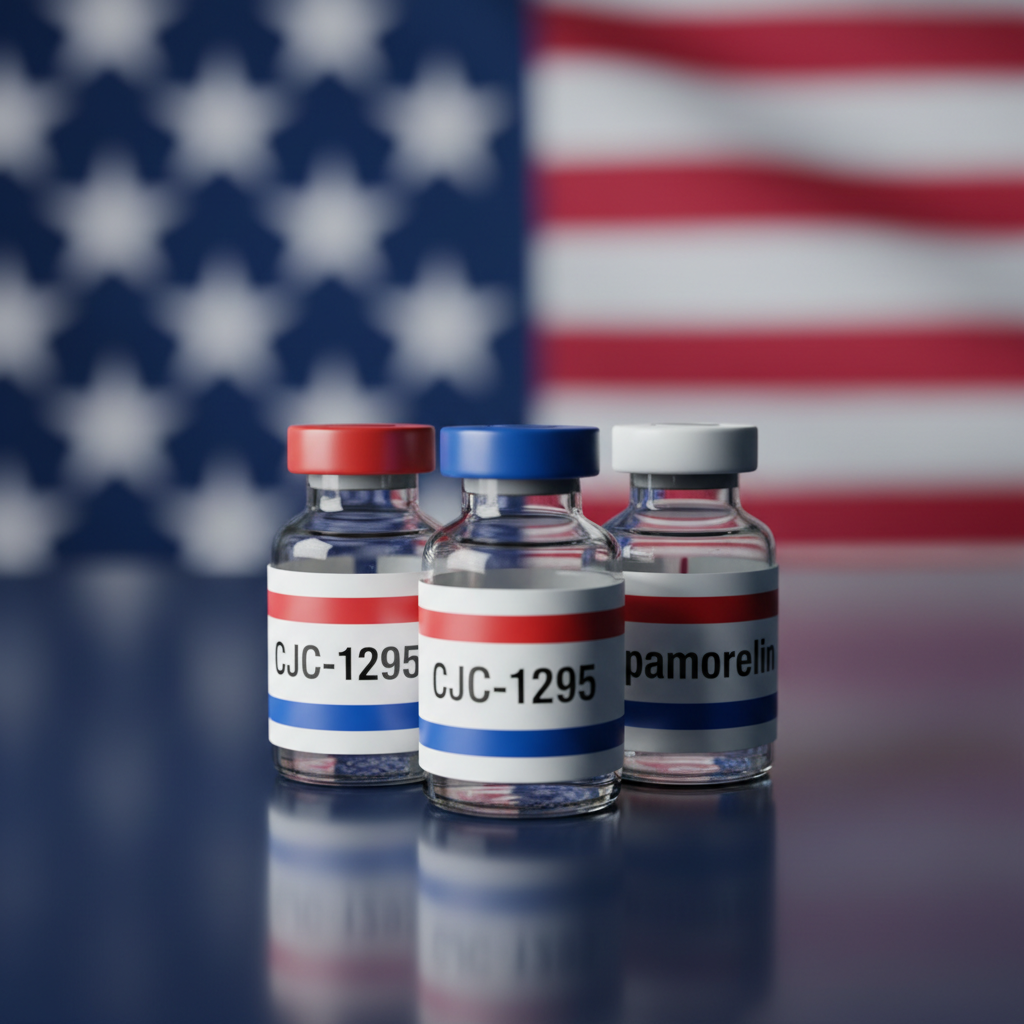
CJC No DAC + Ipamorelin: The Synergistic GHRH/GHRP Stack in Research
CJC No DAC + Ipamorelin: The Synergistic GHRH/GHRP Stack in Research
CJC-1295 No DAC and Ipamorelin are two of the most studied growth hormone secretagogues in modern peptide research. When combined, they act on complementary receptor pathways to produce a pronounced, physiologically patterned GH pulse — without the cortisol and prolactin elevation associated with older GHRP compounds.
refusetofade carries the CJC No DAC + Ipamorelin 5mg combination vial — pre-paired at research-grade purity with a full COA.
Understanding how these two peptides interact requires a working knowledge of the somatotropic axis and the distinct mechanisms each compound engages.
The Somatotropic Axis: A Brief Primer
Growth hormone (GH) secretion from the anterior pituitary is governed by two primary hypothalamic signals operating in opposition:
- GHRH (Growth Hormone-Releasing Hormone) — stimulates GH synthesis and release
- Somatostatin — inhibits GH release, acting as the brake on the system
GH is not secreted continuously. It is released in discrete pulses — typically 6–12 per day in healthy adults — with the largest pulse occurring during slow-wave sleep. The amplitude and frequency of these pulses decline with age, a process central to the research interest in GH secretagogues.
Both CJC No DAC and Ipamorelin work within this axis, but through different receptors and with different functional profiles.
CJC-1295 No DAC (Modified GRF 1-29)
CJC-1295 No DAC — also called Modified GRF 1-29 or Mod GRF 1-29 — is a synthetic analogue of the first 29 amino acids of endogenous GHRH. The native GHRH(1-29) fragment is biologically active but has an extremely short half-life in plasma (under 7 minutes) due to rapid cleavage by dipeptidyl peptidase IV (DPP-IV) at the Ala²-Glu³ bond.
CJC No DAC addresses this through strategic amino acid substitutions:
- Position 2: Alanine → D-Alanine (DPP-IV resistance)
- Position 8: Asparagine → Glutamine (oxidation resistance)
- Position 15: Glycine → Alanine (proteolytic stability)
- Position 27: Methionine → Leucine (oxidation resistance)
These modifications extend the half-life to approximately 30 minutes while preserving full agonist activity at the GHRH receptor (GHRHR). Critically, the "No DAC" designation distinguishes this compound from CJC-1295 with DAC (Drug Affinity Complex), which binds albumin and has a half-life of 6–8 days. The No DAC version produces a pulse-like GH release pattern that more closely mirrors endogenous physiology — a key consideration in research protocols designed to study pulsatile GH dynamics.
Mechanism of Action
CJC No DAC binds the GHRH receptor on somatotroph cells in the anterior pituitary, activating adenylyl cyclase via Gs protein coupling. This increases intracellular cAMP, which in turn:
- Activates protein kinase A (PKA)
- Phosphorylates CREB (cAMP response element-binding protein)
- Upregulates GH gene transcription
- Triggers GH vesicle exocytosis
The result is a dose-dependent increase in GH pulse amplitude. Importantly, CJC No DAC does not suppress somatostatin release, meaning the natural pulsatile rhythm is preserved rather than overridden.
Ipamorelin
Ipamorelin is a pentapeptide (Aib-His-D-2-Nal-D-Phe-Lys-NH₂) and a selective agonist of the ghrelin receptor (GHS-R1a — Growth Hormone Secretagogue Receptor type 1a). It was developed as a third-generation GHRP, designed to retain the GH-releasing potency of earlier compounds (GHRP-2, GHRP-6) while eliminating their off-target hormonal effects.
What Makes Ipamorelin Selective
Earlier GHRPs were potent but non-selective. GHRP-6 significantly elevated cortisol and prolactin alongside GH. GHRP-2 showed similar issues. These elevations complicate research interpretation and raise questions about long-term use in any context.
Ipamorelin was specifically engineered to avoid this. In preclinical studies, it produced robust GH release with no significant elevation of cortisol, prolactin, ACTH, or FSH at research doses. This selectivity makes it the preferred GHRP in most modern research protocols.
Mechanism of Action
Ipamorelin activates GHS-R1a receptors on pituitary somatotrophs through a Gq/11 protein pathway, increasing intracellular calcium via phospholipase C activation. This calcium influx directly triggers GH vesicle fusion and release — a mechanism distinct from and complementary to the cAMP pathway activated by CJC No DAC.
Additionally, Ipamorelin acts at the hypothalamic level to suppress somatostatin release, effectively "releasing the brake" on GH secretion at the same time CJC No DAC is "pressing the accelerator."
The Synergy: Why the Combination Is Studied
The combination of a GHRH analogue (CJC No DAC) and a GHRP (Ipamorelin) produces GH release that is substantially greater than either compound alone — a well-documented synergistic effect in the literature.
The mechanism is dual-pathway amplification:
| Pathway | CJC No DAC | Ipamorelin |
|---|---|---|
| GHRH receptor (Gs/cAMP) | ✓ Direct agonist | — |
| GHS-R1a (Gq/Ca²⁺) | — | ✓ Direct agonist |
| Somatostatin suppression | Indirect (via GH feedback) | ✓ Direct hypothalamic action |
| Cortisol/prolactin elevation | None | None (selective) |
| GH pulse pattern | Physiological (pulsatile) | Physiological (pulsatile) |
When administered together, the two compounds engage both the stimulatory GHRH pathway and the somatostatin-suppressive GHS pathway simultaneously. Research in rodent models has demonstrated GH area-under-curve (AUC) values 2–10x greater than either peptide alone, depending on dose and timing.
Research Findings and Literature Overview
Growth Hormone and IGF-1
The primary downstream marker studied in CJC No DAC + Ipamorelin research is IGF-1 (Insulin-like Growth Factor 1), which is produced in the liver in response to GH signaling and serves as the primary mediator of GH's anabolic and metabolic effects.
Studies in animal models have consistently shown:
- Elevated serum IGF-1 following repeated administration of GHRH + GHRP combinations
- Increased lean body mass in rodent models of GH deficiency
- Reduced adipose tissue in diet-induced obesity models, attributed to GH's lipolytic signaling
- Improved bone mineral density in aging rodent models, consistent with known GH/IGF-1 effects on osteoblast activity
Sleep Architecture
GH secretion is tightly coupled to slow-wave sleep (SWS). Research into GHRH analogues has examined whether exogenous GHRH administration can enhance SWS quality — a finding with implications for recovery and neurological research. Several studies have demonstrated that GHRH administration increases SWS duration and GH pulse amplitude during sleep, suggesting a bidirectional relationship between GHRH signaling and sleep architecture.
Tissue Repair and Collagen Synthesis
GH and IGF-1 are both implicated in collagen synthesis and connective tissue remodeling. Animal studies examining tendon and ligament repair have shown accelerated healing in GH-replete versus GH-deficient models. Research into GHRH/GHRP combinations in this context is ongoing, with particular interest in musculoskeletal recovery models.
Neuroprotection
GH receptors are expressed throughout the CNS, and IGF-1 crosses the blood-brain barrier. Emerging research has examined the neuroprotective potential of GH secretagogues in models of neurodegeneration and ischemic injury. While this remains an early-stage research area, the expression of GHS-R1a in hippocampal and cortical neurons has generated interest in the cognitive and neuroprotective dimensions of ghrelin pathway activation.
Research Protocol Considerations
Dosing Windows
The short half-life of CJC No DAC (~30 minutes) and Ipamorelin (~2 hours) means timing relative to the natural GH pulse cycle is a relevant variable in research design. Most protocols in the literature administer both compounds simultaneously, typically:
- Pre-sleep administration — to amplify the largest natural GH pulse
- Post-fast administration — to study GH dynamics in a low-insulin state (insulin suppresses GH release)
Storage and Reconstitution
Both peptides are supplied as lyophilized powder. Standard reconstitution uses bacteriostatic water (BAC water). Reconstituted solutions should be stored at 4°C and used within 28–30 days. Avoid repeated freeze-thaw cycles, which degrade peptide integrity.
For precise reconstitution calculations, the refusetofade Peptide Calculator provides volume and concentration guidance for any vial size and target dose.
Purity Requirements
Research validity depends on peptide purity. Both CJC No DAC and Ipamorelin should be verified at ≥99% purity via HPLC, with mass spectrometry confirmation of molecular weight. Certificate of analysis (CoA) documentation is non-negotiable for any serious research application.
Research Summary
| Parameter | CJC No DAC | Ipamorelin | Combined |
|---|---|---|---|
| Receptor target | GHRHR | GHS-R1a | Both |
| Half-life | ~30 min | ~2 hours | — |
| GH pulse pattern | Physiological | Physiological | Amplified physiological |
| Cortisol elevation | None | None | None |
| Prolactin elevation | None | None | None |
| IGF-1 upregulation | Moderate | Moderate | Synergistic |
| Somatostatin suppression | Indirect | Direct | Dual-pathway |
Acquire Research-Grade CJC No DAC + Ipamorelin
refusetofade supplies CJC No DAC + Ipamorelin 5mg as a combined lyophilized research peptide — 99%+ purity, third-party tested, certificate of analysis included.
For research purposes only. Not for human or veterinary use.