
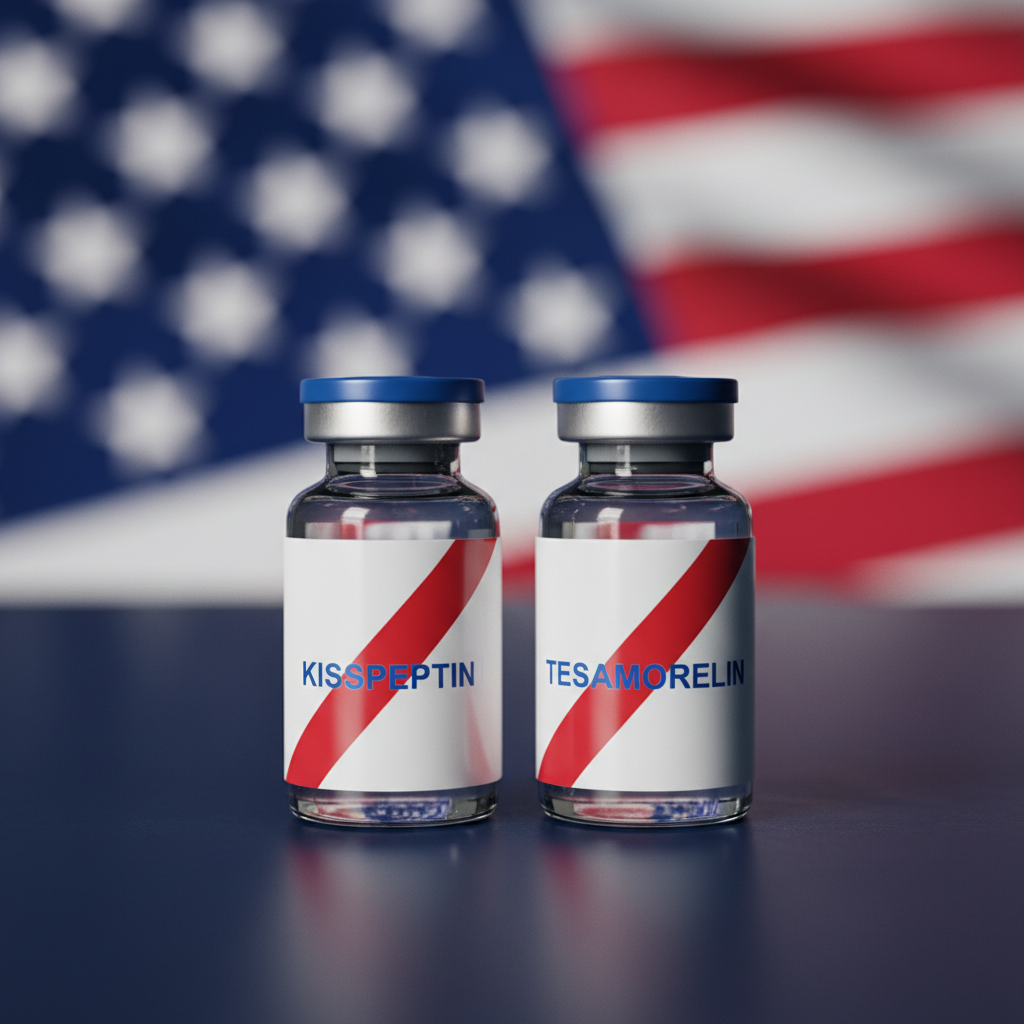
Kisspeptin and Tesamorelin: Hormonal Axis Research in Modern Peptide Science
Kisspeptin and Tesamorelin: Hormonal Axis Research in Modern Peptide Science
The endocrine system operates through cascades — signals that travel from the hypothalamus to the pituitary to peripheral glands, amplifying and modulating at each step. Two peptides have become important research tools for investigating these cascades at different levels: Kisspeptin, which sits at the top of the reproductive hormone axis, and Tesamorelin, a synthetic analogue of growth hormone-releasing hormone (GHRH) that drives GH secretion from the anterior pituitary.
Kisspeptin: Master Regulator of the HPG Axis
Kisspeptin is a neuropeptide encoded by the KISS1 gene, originally identified as a metastasis suppressor before its central role in reproductive endocrinology was recognized. It is produced primarily in two hypothalamic nuclei: the arcuate nucleus (ARC) and the anteroventral periventricular nucleus (AVPV).
The HPG Cascade
The hypothalamic-pituitary-gonadal (HPG) axis governs reproductive function in all mammals. Kisspeptin is now understood to be the primary driver of gonadotropin-releasing hormone (GnRH) secretion — the first step in the cascade:
- Kisspeptin → binds KISS1R (GPR54) on GnRH neurons
- GnRH → released into the hypophyseal portal system
- LH and FSH → secreted from anterior pituitary gonadotrophs
- Testosterone / Estradiol / Progesterone → produced by gonads
Without kisspeptin signaling, GnRH neurons are largely quiescent. Loss-of-function mutations in KISS1 or KISS1R result in hypogonadotropic hypogonadism — a complete failure of pubertal development and reproductive function.
Pulsatility and the KNDy System
Kisspeptin neurons in the arcuate nucleus co-express neurokinin B (NKB) and dynorphin — a combination that has led to their designation as KNDy neurons. This triad creates an autocrine oscillator:
- NKB stimulates kisspeptin release (via NK3R on KNDy neurons)
- Dynorphin inhibits kisspeptin release (via KOR on KNDy neurons)
- The result is pulsatile GnRH secretion, which is essential for normal pituitary responsiveness
Research into KNDy neuron dynamics has significant implications for understanding fertility, puberty timing, and the neuroendocrine effects of metabolic status on reproduction.
Research Applications
Kisspeptin (5mg vial) is used in research protocols investigating:
- GnRH pulse generation and LH pulsatility
- Pubertal timing mechanisms
- Metabolic-reproductive axis interactions (kisspeptin neurons are sensitive to leptin, insulin, and energy status)
- Sex steroid feedback on the HPG axis
Kisspeptin-10 (the C-terminal decapeptide) and kisspeptin-54 are the most commonly used forms in research. Both activate KISS1R with high potency.
Tesamorelin: Synthetic GHRH for Growth Hormone Research
Tesamorelin is a synthetic analogue of human growth hormone-releasing hormone (GHRH), with a trans-3-hexenoic acid group added to the N-terminus to extend its half-life. The native GHRH(1-44) has a plasma half-life of less than 5 minutes due to rapid cleavage by dipeptidyl peptidase IV (DPP-IV); Tesamorelin's modification confers significantly greater stability.
Mechanism: The Somatotropic Axis
The growth hormone axis operates through a push-pull mechanism:
- GHRH (from hypothalamus) → stimulates GH secretion from somatotrophs
- Somatostatin (from hypothalamus) → inhibits GH secretion
- GH → acts on liver and peripheral tissues; stimulates IGF-1 production
- IGF-1 → mediates most of GH's anabolic and metabolic effects; provides negative feedback
Tesamorelin acts at the GHRH receptor (GHRHR) on anterior pituitary somatotrophs, stimulating GH release in a pulsatile, physiologically appropriate manner — preserving the normal feedback architecture rather than bypassing it.
Research Profile
Tesamorelin has been studied extensively in the context of:
- Visceral adiposity — GH deficiency and relative GH insufficiency are associated with excess visceral fat accumulation; Tesamorelin's ability to stimulate GH release has made it a research tool for investigating GH's role in fat distribution
- Metabolic effects of GH — lipolysis, insulin sensitivity, and lipid metabolism are all GH-regulated; Tesamorelin provides a tool to modulate GH levels without exogenous GH administration
- Cognitive function — GH and IGF-1 receptors are expressed throughout the brain; research has examined GH axis effects on memory, processing speed, and neuroplasticity
- Body composition — lean mass, bone density, and muscle protein synthesis are all influenced by GH/IGF-1 signaling
Reconstitution Protocol
Tesamorelin (10mg vial) should be reconstituted in bacteriostatic water. The peptide is sensitive to agitation — vials should be rotated gently rather than shaken. Reconstituted solutions should be stored at 4°C and used within 21 days. Lyophilized powder is stable at -20°C for extended periods.
Comparing the Two Peptides
| Parameter | Kisspeptin | Tesamorelin |
|---|---|---|
| Target axis | HPG (reproductive) | Somatotropic (GH) |
| Primary receptor | KISS1R (GPR54) | GHRHR |
| Downstream hormones | GnRH → LH/FSH → sex steroids | GH → IGF-1 |
| Research focus | Fertility, puberty, neuroendocrinology | Body composition, metabolism, cognition |
| Vial size | 5mg | 10mg |
| Half-life consideration | Short; pulsatile administration in protocols | Extended vs. native GHRH due to DPP-IV resistance |
Conclusion
Kisspeptin and Tesamorelin are tools for investigating two of the most important axes in endocrinology. Kisspeptin provides access to the upstream control of reproductive hormone cascades — a level of the HPG axis that was largely inaccessible to researchers before its discovery. Tesamorelin offers a physiologically appropriate means of stimulating GH secretion, preserving feedback architecture while enabling investigation of GH's broad metabolic and anabolic effects.
Both peptides require careful handling, verified purity, and experimental designs that account for the pulsatile nature of the hormonal systems they engage.
All products sold by Refuse to Fade are for research purposes only. Not for human or veterinary use.