
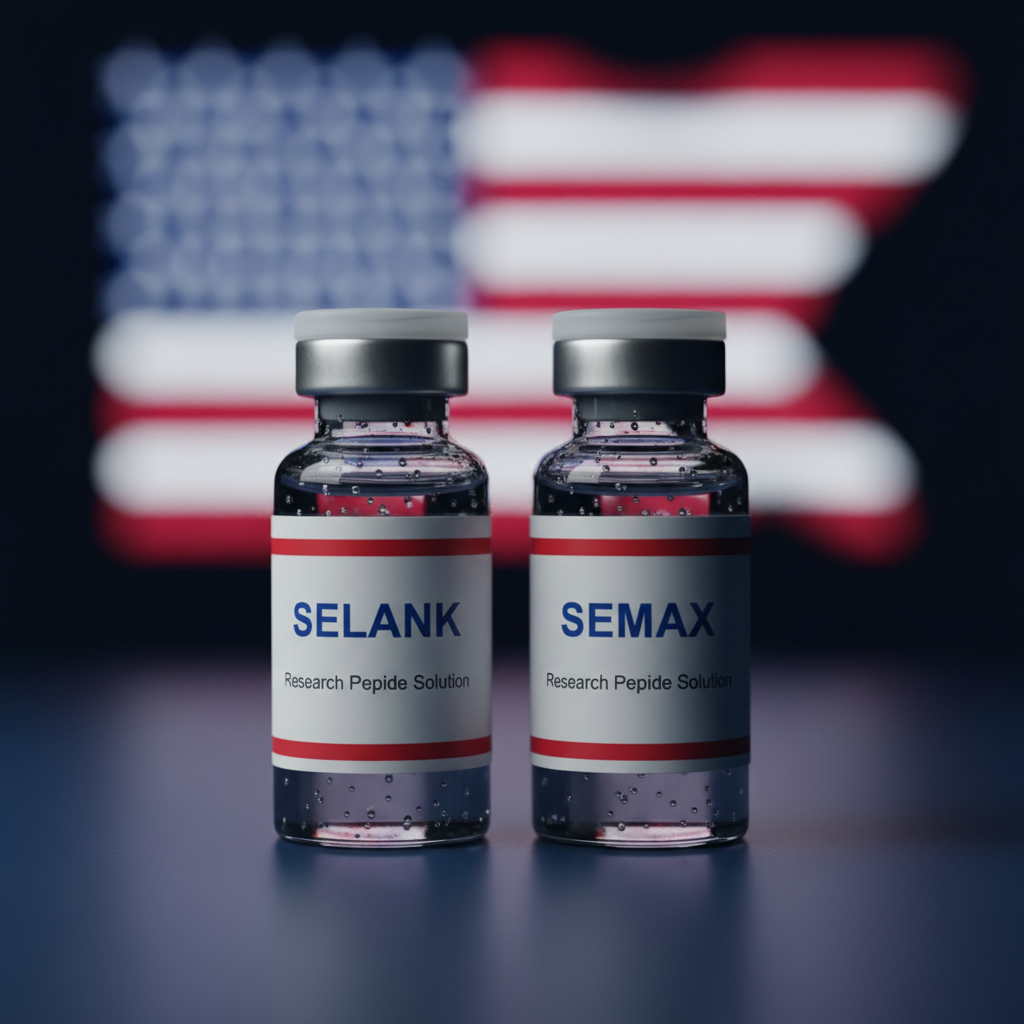
Selank vs. Semax: A Researcher's Guide to Nootropic Peptides
Selank vs. Semax: A Researcher's Guide to Nootropic Peptides
Two synthetic peptides. Both developed by the Institute of Molecular Genetics of the Russian Academy of Sciences. Both studied extensively for cognitive and neurological effects. Yet Selank and Semax represent meaningfully different research directions — and understanding those differences is essential for any serious investigator.
Origins and Structure
Selank is a heptapeptide (Thr-Lys-Pro-Arg-Pro-Gly-Pro) derived from the endogenous immunomodulatory peptide tuftsin. Its sequence was modified to extend metabolic stability while preserving and enhancing the anxiolytic properties of its parent compound.
Semax is a synthetic analogue of the adrenocorticotropic hormone (ACTH) fragment 4–7, extended with a Pro-Gly-Pro sequence to improve CNS penetration and resist enzymatic degradation. Its full sequence is Met-Glu-His-Phe-Pro-Gly-Pro.
Both peptides are administered intranasally in most research protocols, allowing direct delivery to the CNS via the olfactory pathway — bypassing the blood-brain barrier with high efficiency.
Mechanisms of Action
Selank
Selank's primary mechanism involves modulation of the GABAergic system. Research suggests it increases the expression of GABA-A receptor subunits, producing anxiolytic effects comparable to benzodiazepines — but without the sedation, tolerance development, or withdrawal profile associated with that drug class.
Additional mechanisms under investigation include:
- BDNF upregulation — Selank has been shown in animal models to increase brain-derived neurotrophic factor expression, supporting neuroplasticity research
- Enkephalin stabilization — inhibition of enkephalin-degrading enzymes, potentially contributing to mood regulation
- Immune modulation — tuftsin-derived activity on macrophage and T-cell function, studied in the context of stress-related immune suppression
Semax
Semax operates primarily through BDNF and NGF (nerve growth factor) upregulation. Its ACTH-derived sequence interacts with melanocortin receptors (MC4R in particular), which are expressed throughout the CNS and are implicated in attention, memory consolidation, and neuroprotection.
Key research areas for Semax include:
- Cognitive enhancement — improved working memory and attention in rodent models; human studies in Russia have examined its use in stroke recovery and cognitive decline
- Neuroprotection — demonstrated reduction of ischemic damage in animal models, attributed to BDNF/NGF upregulation and anti-inflammatory signaling
- Dopaminergic activity — evidence of dopamine system modulation, relevant to motivation and executive function research
Comparing Research Profiles
| Parameter | Selank | Semax |
|---|---|---|
| Primary mechanism | GABAergic / anxiolytic | BDNF/NGF / cognitive |
| Receptor targets | GABA-A, enkephalin system | MC4R, TrkB (BDNF receptor) |
| Primary research focus | Anxiety, stress, immune function | Memory, neuroprotection, cognition |
| Half-life (intranasal) | ~2 minutes (active metabolites persist longer) | ~2 minutes (active metabolites persist longer) |
| Purity requirement | ≥99% for research validity | ≥99% for research validity |
Research Considerations
Both peptides are highly sensitive to storage conditions. Lyophilized powder should be kept at -20°C until reconstitution. Once reconstituted in bacteriostatic water, solutions should be stored at 4°C and used within 30 days.
Sequence verification via HPLC and mass spectrometry is non-negotiable for research-grade material. Impurities at even sub-1% levels can confound results in behavioral assays, where effect sizes are often modest and dose-dependent relationships are steep.
Conclusion
Selank and Semax are not interchangeable. Selank is the more appropriate compound when the research question involves anxiety, stress response, or immune-neurological interaction. Semax is better suited to investigations of cognitive enhancement, neuroprotection, and BDNF-mediated plasticity.
Both require the same standard of purity, proper reconstitution, and rigorous experimental design. Neither is approved for human use. All research must comply with applicable institutional and regulatory guidelines.
All products sold by Refuse to Fade are for research purposes only. Not for human or veterinary use.