
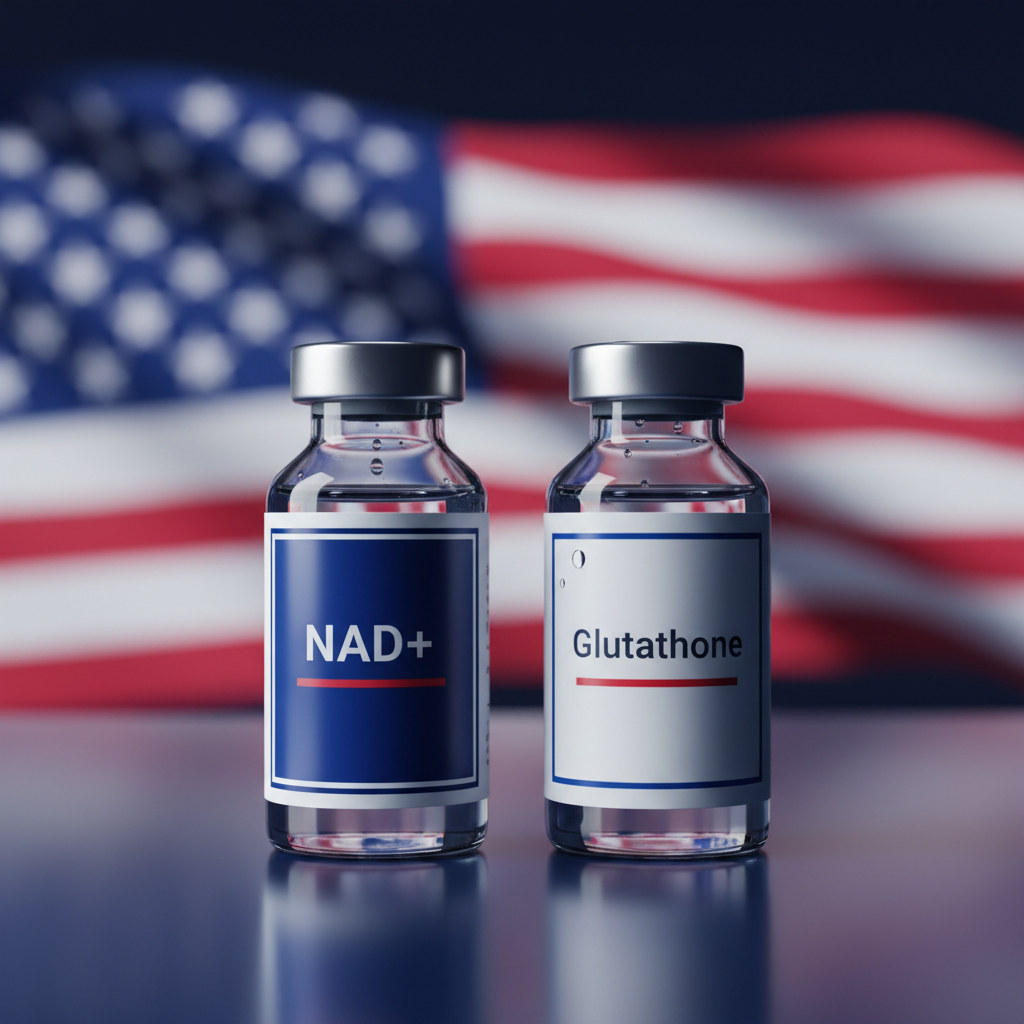
NAD+ and Glutathione: The Cellular Foundations of Longevity Research
NAD+ and Glutathione: The Cellular Foundations of Longevity Research
The biology of aging is complex, but two molecules appear consistently at the center of the research: nicotinamide adenine dinucleotide (NAD+) and glutathione. Both decline significantly with age. Both are critical to cellular function. And both have become primary targets in the growing field of longevity science.
NAD+: The Energy Currency of Cellular Repair
NAD+ is a coenzyme found in every living cell. It exists in two forms — NAD+ (oxidized) and NADH (reduced) — and cycles between them as it shuttles electrons through metabolic reactions. This cycling is central to ATP production in the mitochondria, making NAD+ indispensable to cellular energy metabolism.
But NAD+'s role extends far beyond energy production.
Sirtuins and DNA Repair
Sirtuins (SIRT1–SIRT7) are a family of NAD+-dependent deacylases that regulate gene expression, DNA repair, and stress response. They require NAD+ as a co-substrate — meaning that as NAD+ levels decline with age, sirtuin activity falls proportionally.
Research on sirtuin activation has linked NAD+ availability to:
- Telomere maintenance — SIRT1 and SIRT6 play roles in protecting telomere integrity
- Mitochondrial biogenesis — SIRT1/PGC-1α signaling promotes the formation of new mitochondria
- DNA double-strand break repair — SIRT6 is recruited to sites of DNA damage and facilitates repair machinery
PARP Enzymes and Genomic Stability
Poly(ADP-ribose) polymerases (PARPs) are another major consumer of NAD+. PARP1 is activated by DNA strand breaks and uses NAD+ to synthesize poly(ADP-ribose) chains that recruit repair proteins. In aged tissue, chronic low-level DNA damage leads to persistent PARP activation, accelerating NAD+ depletion.
This creates a feedback loop: declining NAD+ impairs repair capacity, which increases DNA damage, which further depletes NAD+.
Research Dosing Considerations
NAD+ is typically supplied as a lyophilized powder for research applications. Reconstitution in sterile bacteriostatic water is standard. Stability is temperature-sensitive — reconstituted solutions should be used promptly or stored at -20°C.
At 500mg per vial, Refuse to Fade's NAD+ is formulated for research protocols requiring higher-dose investigation of cellular energy and repair pathways.
Glutathione: The Master Antioxidant
Glutathione (γ-L-glutamyl-L-cysteinyl-glycine, or GSH) is a tripeptide synthesized endogenously from glutamate, cysteine, and glycine. It is the most abundant intracellular antioxidant in mammalian cells, present at millimolar concentrations in the cytoplasm, nucleus, and mitochondria.
Mechanisms of Antioxidant Defense
Glutathione neutralizes reactive oxygen species (ROS) through two primary mechanisms:
- Direct scavenging — GSH donates a hydrogen atom to neutralize hydroxyl radicals, lipid peroxides, and other ROS, becoming oxidized glutathione (GSSG) in the process
- Enzymatic reduction — Glutathione peroxidase (GPx) uses GSH to reduce hydrogen peroxide and organic hydroperoxides; glutathione reductase then regenerates GSH from GSSG using NADPH
This cycle is critical: when GSH cannot be regenerated fast enough — due to oxidative overload or NADPH depletion — the cell shifts toward an oxidized state, impairing protein function, damaging lipid membranes, and triggering apoptotic signaling.
Detoxification and Immune Function
Beyond antioxidant defense, glutathione plays essential roles in:
- Phase II detoxification — conjugation with electrophilic compounds via glutathione S-transferases (GSTs), facilitating their excretion
- Immune cell proliferation — T-cell activation and NK cell cytotoxicity are both glutathione-dependent
- Protein folding — maintenance of the redox environment in the endoplasmic reticulum, critical for correct disulfide bond formation
Age-Related Decline
Glutathione levels decline by approximately 30–50% between young adulthood and old age in most tissues. This decline is attributed to reduced synthesis (lower expression of glutamate-cysteine ligase), increased consumption by chronic oxidative stress, and impaired regeneration.
Research into exogenous glutathione supplementation has historically been complicated by poor oral bioavailability. Injectable and liposomal forms have shown better tissue uptake in preclinical models.
The NAD+–Glutathione Axis
These two molecules are not independent. NAD+ and glutathione are metabolically linked through NADPH — the reduced form of NADP+, which is generated by the pentose phosphate pathway and used by glutathione reductase to regenerate GSH from GSSG.
When NAD+ metabolism is disrupted, NADPH availability can be affected, impairing glutathione recycling. Conversely, high oxidative stress depletes glutathione and increases NADPH consumption, which can divert metabolic flux away from NAD+ synthesis pathways.
This interconnection makes combined investigation of both molecules a productive research direction in aging biology.
Conclusion
NAD+ and glutathione represent two of the most mechanistically grounded targets in longevity research. Their decline with age is well-documented. Their roles in DNA repair, energy metabolism, antioxidant defense, and immune function are deeply characterized. And their interaction through the NADPH axis suggests that studying them in isolation may miss important systems-level dynamics.
For researchers investigating cellular aging, both compounds warrant rigorous, well-controlled experimental design — with verified purity, proper reconstitution, and appropriate controls.
All products sold by Refuse to Fade are for research purposes only. Not for human or veterinary use.